Free Anatomy and Physiology Course for OT Students

When I was an Occupational Therapy student, I desperately wanted a go-to resource for anatomy and physiology. The vocabulary, the diagrams, the connections – it was all just so, so much. So one of the things I really wanted on this site was something to help OT students. It’s now 2025 and I have added a whole new section to my site’s menu just for OT Students. And the first thing I’m making available is a FREE Anatomy and Physiology Course for OT Students!

You don’t even have to become a site member. Each video lesson will be public on Youtube as well as available on the Students page here on my site.

Each lesson will come with an interactive ebook of exercises on the material covered. And all you have to do to download the book is fill in your name email and click the button!

Not only is this a great go-to resource for OT students, but it’s also FREE and it comes with no commitment.

Anatomy & Physiology Videos for OT students – learn anytime, anywhere!

The course will include 6 video lessons. The first lesson is out and live right now.

New lessons will be released Thursdays in January and February of this year, along with the accompanying ebooks.

So keep checking in as the course gets updated week-to-week!


Are You an OT Student?

Are you struggling with the amount of material in Anatomy and Physiology? Or maybe there is another topic you would like to know more about?

If you have an idea for another lesson, or if you have any questions at all, please feel free to contact me. I look forward to hearing from you!


Ready to get started with my Free Anatomy and Physiology Course for OT Students?

CLICK HERE!


Lessons in this Free Anatomy and Physiology Course for OT Students:

Lesson 1 – Anatomical Terms and Directional Planes

To be released Thursday January 9th, 2025 – Now Live!

Lesson 2 – Types of Tissues in the Human Body

To be released Thursday January 16th, 2025 – Now Live!

Lesson 3 – To be released Thursday, January 23rd, 2025.

Lesson 4 – To be released Thursday, January 30th, 2025.

Lessson 5 – To be released Thursday, February 6th, 2025.

Lesson 6 – To be released Thursday, February 13th, 2025.

COURSE – Therapeutic Strategies Torticollis and Plagiocephaly

A parent reached out to me looking for strategies that helped with Torticollis and Plagiocephaly. She was worried about the long-term and short-term effects. on her child’s development. After putting some ideas together and working with this one parent, I immediately thought this could help many parents and occupational therapists facing similar problems and worries. I mean, why not share this valuable information as soon as possible on my site? After all, the goal of this site is to be the problem-solving resource I always wished I had—a place to find practical answers to pressing issues in Pediatric Occupational Therapy like this course – Therapeutic Strategies Torticollis and Plagiocephaly

And so here it is!


COURSE – Therapeutic Strategies Torticollis and Plagiocephaly

This 2-hour course is designed to equip occupational therapy practitioners with evidence-based knowledge and practical strategies to manage the common pediatric conditions of torticollis and plagiocephaly. Participants will explore the underlying causes and clinical presentations of torticollis, along with the associated craniofacial asymmetries of plagiocephaly. The course will delve into the impact of these conditions on motor development and provide actionable intervention techniques to promote symmetrical alignment and functional outcomes. Included – Home Program Handout for parents/guardians.


Dr Aditi the OT - Therapeutic Strategies Torticollis and Plagiocephaly Title Screenshot 1
Screen shot from the Dr Aditi the OT Therapeutic Strategies Torticollis and Plagiocephaly Video Course


COURSE – Therapeutic Strategies Torticollis and Plagiocephaly Learning Objectives

Upon completion of this course, you will be able to:

  1. List the impact of torticollis and plagiocephaly on motor development.
  2. List 4 intervention strategies to address torticollis and symmetrical alignment.


THIS COURSE IS AVAILABLE AS PART OF THE PREMIUM MEMBERSHIP

Simply sign up to the PREMIUM Membership and you get full access to this course, a certificate for your CEUs, and access to every course and resource on the Dr Aditi the OT site for a full year – $59.99.

Click here to sign up for the yearly Membership!

[vc_btn title=”Become a PREMIUM Member” style=”custom” custom_background=”#87cb28″ custom_text=”#ffffff” align=”center” button_block=”true” link=”url:https%3A%2F%2Fdradititheot.com%2Fproduct%2Fdr-aditi-the-ot-premium-membership%2F|title:Become%20a%20PREMIUM%20Member||”]

 – – –

If you would like to learn more about this course and the specific learning objectives,
go to the Course Page by clicking here.

COURSE – Trauma-Informed Care in OT

Trauma-informed care could make all the difference for the professional OT. How prepared are you to handle the sensitive situations that come up? Do you know how to navigate your client and yourself through the issues that can come after trauma? This course – Trauma-Informed Care in OT – prepares you to make the difference your clients need in addressing trauma.


COURSE – Trauma-Informed Care in OT

In this course, we will explore the significance of recognizing and addressing the complex impacts of trauma on both clients and practitioners. You will not only tailor interventions that foster deeper therapeutic connections, but also grow in personal sensitivity. Learn how to use evidence-based strategies rooted in trauma-informed principles to cultivate an empathetic foundation. Let’s navigate the complexities of trauma in OT practice together.

Dr Aditi the OT Trauma-Informed Care Course Screenshot 1
Screen shot from the Dr Aditi the OT Trauma-Informed Care Course

COURSE – Trauma-Informed Care in OT Learning Objectives

Upon completion of this course, you will be able to:

  1. Define basic principles of trauma and trauma-informed approaches.
  2. Describe the impact of trauma on the brain and human behavior.

THIS COURSE IS AVAILABLE AS PART OF THE PREMIUM MEMBERSHIP

Simply sign up to the PREMIUM Membership and you get full access to this course, a certificate for your CEUs, and access to every course and resource on the Dr Aditi the OT site for a full year – $59.99.

Click here to sign up for the yearly Membership!

[vc_btn title=”Become a PREMIUM Member” style=”custom” custom_background=”#87cb28″ custom_text=”#ffffff” align=”center” button_block=”true” link=”url:https%3A%2F%2Fdradititheot.com%2Fproduct%2Fdr-aditi-the-ot-premium-membership%2F|title:Become%20a%20PREMIUM%20Member||”]

 – – –

If you would like to learn more about this course and the specific learning objectives,
go to the Course Page by clicking here.

COURSE – Occupational Therapy Code of Ethics

Have you ever asked why we would need a course on the Occupational Therapy Code of Ethics? Certainly, we all sort of know the right and wrong thing to do, right?

Well, yes! But we work with sensitive information in sensitive situations. And the code of ethics provides a framework of the core values of our profession. So this is where you get an advantage with my course – Occupational Therapy Code of Ethics. My two-hour overview of the OT ethics code helps practitioners manage everyday ethical responsibilities. Most importantly, you will use ethical decision-making models and case studies applying real life ethical issues.

SPECIAL NOTE: This course counts toward your required ethics CEUs!

Course – Occupational Therapy Code of Ethics

Dr Aditi the OT OT Code of Ethics Course Screenshot
Screen shot from the Dr. Aditi the OT Code of Ethics Course


Course – Occupational Therapy Code of Ethics Learning Objectives

Upon completion of this course, you will be able to:

  1. Identify the basic similarities and differences between ethics and morals
  2. Differentiate between common ethical theories, morality and ethical behavior
  3. Interpret and apply the AOTA’s Occupational Therapy Code of Ethics, & more

Simply sign up to the PREMIUM Membership. You get full access to this course, a certificate for your CEUs, and access to other courses and resources.

CLICK HERE TO SIGN UP:

[vc_btn title=”Become a Member” style=”custom” custom_background=”#1c2143″ custom_text=”#ffffff” align=”center” button_block=”true” link=”url:https%3A%2F%2Fdradititheot.com%2Fmembership-join%2F|title:Become%20a%20Member||”]

 – – –

If you would like to learn more about this course and the specific learning objectives,
go to the Course Page by clicking here.

3 Non-Traditional Ways to Earn Online OT CEUs

Occupational therapy is a noble profession that helps clients achieve the best outcome in their professional and personal lives. The primary purpose of an occupational therapist is to engage in continuing professional development activities and respond to the needs of their clients. To ensure the best service to their clients, OTs need to stay up-to-date with the regular transformation in this field. Furthermore, they also have to meet specific state license and regulatory requirements. Continuing education in occupational therapy is one such requirement that brings along several perks. There are several traditional ways to earn OT CEUs. However, this blog will highlight non-traditional ways to earn Online OT CEUs.

#1- Reading Journal Articles

Some states in the United States grant Continuing Education Unit credits for reading journal articles. It can also add to your professional development unit. A list of States where an Occupational therapist can earn CEUs credits by reading journal articles are-

  • Illinois
  • Kentucky
  • Maryland
  • Nebraska
  • Ohio
  • Washington 
  • West Virginia

Another thing to remember is that you cannot read textbook chapters if it is required for academic coursework purposes.  It does need to be an independent article outside the recommended readings for your coursework.

Here are the steps involved:

  1. Highlight a topic you are interested in.  Use boolean terms like Traumatic Brain Injury AND sensory processing.
  2. Search for articles on membership websites like AOTA
  3. If you are looking for free articles, then open access journals are your best bet.   Websites like: PubMed, Google Scholar, Proquest etc.   These websites allow you access the full text of journal articles without having to pay or commit to a subscription.  
  4. Read the article and write a paragraph about the main points of the article, how it applies to you in your practice and don’t forget to include an annotated bibliography.
  5. Submit the form to NBCOT

As per NBCOT guidelines, you can earn up to 36 units in a year reading relevant  articles in your field.  Also, you need to read/ write about 2 articles or 2 chapters to earn 1 PDU for continuing education in OT.

Remember to check out the requirements for your specific state, as each state has unique guidelines regarding reading journal articles. 

Here is a list of open-access articles I would recommend for OTs that are more general and can be applied to practitioners working in any setting:


  1. Park E. Y. (2021). Meta-Analysis of Factors Associated with Occupational Therapist Burnout. Occupational therapy international, 2021, 1226841. 
  2. Lin, Tiffany & Fisher, Gail. (2020). Applying the Model of Human Occupation During the Pandemic Stay-at-Home Order. The Open Journal of Occupational Therapy. 8. 1-7. 10.15453/2168-6408.1770.
  3. Breuer, Kelly; Cink, Christina; Geisler, Shawna; Hillstrom, Hannah; Ice, Cerena; Kreuser, Olivia; Mazurkevicz, Ladislava; Schommer, Hallie; and Bass, Jullie D.. (2019). Trauma and Health Outcomes: An Evidence-based Practice Project.

#2- Level II Fieldwork

Just like reading Journal Articles, Some states in the United States of America recognize level II fieldwork as a viable way to earn CEUs. Working with the state licensing agencies is generally advised to bring the most out of your fieldwork. No more than 12 hours can be earned from level II field work. Some aspects to keep in mind while being a part of Level II fieldwork are-

  • The supervision must be direct for an OT student doing level II fieldwork.
  • The licensee must be the main supervisor. 
  • Supervision can not be the primary responsibility of employment.
  • Certification of the supervision from the OT program, a record of the student supervised along with dates and times of supervision must be submitted to receive credit.

#3- Continuing education Presentation

Lastly, presentations by licensees at conferences and or professional organizations are a great way to earn some CEUs Units.. Though counted only once, there is no limit on hours that can be earned with it. However, presentations for community organizations have a limit of 8 hours. 

Another thing to remember is that creating online CEU courses for OT can also be a brilliant little side hustle.  Creating evergreen content on popular evidence-based topics are always in high demand and this is one side hustle that is easy to fit into your flexible schedule.  Interested in learning more?  

Sign up for my “Create an online CEU course” which covers everything you need to know to select, research, create and sell your evergreen continuing education course to multiple vendors.  Sign up here.

[contact-form-7 id=”1401″ title=”Pre-Register for Creating Online Courses”]


How Can You Use Burps, Farts and Fairy Tales to Teach Handwriting? A Motivational Tale

Motivating students to write when they are struggling with handwriting can be a painful task for any therapist/ educator.  When a student has no motivation, he/ she may just “go through the motions” or they may simply refuse……either way it can halt progress and leave both of  you (teacher and learner) feeling hopeless. Who would have guessed the solution involved using Burps, Farts and Fairy Tales to Teach Handwriting!

Luca Canever, a Spec Ed. teacher from Italy. When I learned about how he successfully motivated his students using fairy tales… I was immediately intrigued.  I did not hesitate to sign up for his webinar and it was eye-opening, to say the least.  He used client factors and a client-centered approach in his interventions. This spoke volumes to me as an OT. I learned so much!  I was in awe.

We as OTs all know that when any task is hard, motivation tends to be low. Why? Simply put, success is not always imminent.  Low motivation can be  detrimental in many ways, especially with the task of teaching handwriting.  An intrinsically motivated student can often push through the struggle, however sometimes students need some extrinsic motivation to get them through this hump.


So, What Influences Motivation? Can I Use Burps, Farts and Fairy Tales to Teach Handwriting?

There are many factors that influence motivation including our values, attitudes, interests etc., but our past experiences also have an overwhelming impact on our motivational level.   Let me explain…

If a student struggles with handwriting, they may develop a negative association with this task and will certainly not gain the motivation to keep going.  However, we know that the only way to get better at handwriting is to practice the task of handwriting !  The other problem is that this aversion to handwriting can often become a self- fulfilling prophecy i.e. a student might find themselves thinking the following way…..

“ I can’t do it, I’m not good at it.”  But If I don’t practice, I will never get good at it..”    This can become a never ending cyclical problem.  IT is also important to note that “ I can’t” often translates to “ I don’t like”  which further strengthens a negative association with handwriting.

Luca encountered this very problem with his special needs student we shall call Leo. Leo negatively associated handwriting with boredom and frustration. Therefore, he simply never held enough motivation to practice it.

How Luca used Burps, Farts and Fairy tales to Teach Handwriting and Motivate his Student

Now, Luca had worked with Leo for over 4 years on cursive writing.  Leo was an 18 year old boy with mildly cognitive disabilities, poor fine motor skills. To make things worse, Leo took several medications which made his hands tremor and shake.  This aspect made handwriting even more  challenging for Leo and in turn created a further aversion to handwriting.

Handwriting Sample which led to using Burps, Farts and Fairy Tales to Teach Handwriting

Luca’s actual goal was for Leo to practice writing in cursive sentences upon dictation.  However, Leo was always very hesitant and aversive to participate in handwriting.  He would shut down out of frustration with any writing tasks.  Leo needed opportunities to practice so that he could get better and feel ‘good’ about handwriting again. Luca knew that if he could get him to practice and provide Leo with the positive reinforcement he needed, that could change things.   But the question was how?

Luca used a client-centered approach by looking at the client factors.  He tried to learn as much as he could about Leo’s specific interests and wondered if there was a subject or theme that might influence his performance in the handwriting.

Luca soon realized that Leo loved to draw and like most pre-teen boys, farting and burping was an amusing topic on any day.  These ‘interests,’ or what we would call ‘client factors’ in OT, were exactly what Luca decided to harness.


Burps, Farts and Fairy Tales to Teach Handwriting – Example Exercise

So Luca created a handwriting template “Whitesnow and the Seven Farts” by adapting the popular story of Disney’s Snow white and the 7 Dwarfs.  Using this template, Luca encouraged Leo to write his own version of Snow White who soon became a burping and farting princess.

Revised Fairy Tale Text Used with Burps, Farts and Fairy Tales to Teach Handwriting Copyright 2022 @ Canever

Luca also created this lined visual template, to help Leo with his visual perceptual skills when writing:

Handwriting Exercise Sample using Burps, Farts and Fairy Tales to Teach HandwritingCopyright 2022 @ Canever

Below is an example of how Luca also incorporated Leo’s love for drawing.  Leo would write about the The 3 little pigs and  he also drew his own burping, farting version.  So  instead of just having Leo re-write the traditional somewhat boring story, Luca now had Leo writing about the pigs farting bricks.   That did the trick!   

Student Artwork based on Burps, Farts and Fairy Tales to Teach Handwriting

Copyright 2022 @ Canever


Burps, Farts and Fairy Tales to Teach Handwriting – The Science Behind Why it Works

By pairing something the student didn’t like (handwriting) with something he really enjoyed (drawing, burping, farting), Luca was able to make a huge difference for this student.   Now there are a lot of other motivational factors and strategies (Precision Teaching and an acoustic reinforcement strategy called TAGteach) that Luca used, but this became the perfect starting point.

Needless to say that Luca’s brilliant motivational strategy created several hilarious memories for both student and teacher.

If you would like to learn more about the fun and fascinating strategies Lucas used, please sign up for our upcoming webinar on “How to teach handwriting using burps, farts and fairy tales ?”.  In this webinar Luca shares quantitative data showing how much more progress Leo was able to make once he was more motivated.  It was truly transformational !

Upcoming Webinar – How to Teach Handwriting Using Burps, Farts and Fairytales
[contact-form-7 id=”5069″ title=”Sign Up for Upcoming Webinar – How to Teach Handwriting Using Burps, Farts and Fairytales”]

Acoustic reinforcement (TAGteach) is one of the most unique and interesting strategies Lucas showcases in this webinar.  If you would like to learn more about the science of acoustic reinforcement, checkout this OT Continuing Education webinar on Teach handwriting 2X faster using Acoustic Reinforcement.  It has a ton of videos and practical strategies you can implement in everyday practice.


How will you use Burps, Farts and Fairy Tales to Teach Handwriting, or teach something else? Share your experience with a comment or note!

2023 Requirements for Continuing Education in Occupational Therapy!

Occupational therapy is a practice that works on an individual’s day-to-day life skills and makes necessary adjustments to them to enhance their way of life. It is an ideal profession for those who want to bring about positive changes in the lives of others. However, like every other profession, we maintain our licenses by satisfying the requirements for continuing education in Occupational Therapy. But more than this, continuing education courses also give us the chance to keep abreast of the latest evidence-based strategies. So, in this blog, we will discuss various aspects of continuing education, including requirements, types, and required topics.

Requirements for Continuing Education in Occupational Therapy – What, Where, When?

Occupational therapy continuing education can be challenging to grasp as the requirement varies from state to state. While, there are multiple podcasts, workshops, and text-based courses available to help OTs meet the requirements for continuing education in occupational Therapy, there is some confusion about the number of CEUs (Continuing Education Units) required in a particular state, the topics that need to be covered, and the acceptable formats. To make things more complicated the requirements vary depending on the state you live in, and how recently you may have graduated.

According to NBCOT (National Board for Certification in Occupational Therapy), an individual must complete 24 continuing education contact hours each renewal period to maintain the licensure period. However, when it comes to state OT CEU requirements, it varies from state to state. It can range between 18 to 34 credit hours every two years, depending on the state an individual is placed in. These requirements keep on getting updated regularly.

For example, in New Mexico, there was a requirement of 20 OT continuing education hours annually. However, this was recently revised, and starting February 24, 2022, the requirement is now 15 continuing education contact hours annually. Therefore, as an OT, it is important to keep tabs on the changes in the state requirements on a regular basis.

Types of CEU

When discussing occupational therapy continuing education online, it is essential to understand its various types. One can enroll in an online continuing education course, read articles, attend workshops or listen to the podcast to meet their CEU requirements. However, as mentioned earlier, it is always a good idea to check in with your state OT laws because there may be a limit to the number of hours obtained within each category and type of continuous education courses.

Must have CEU Topics

Each state varies in its specifications for subject matter requirements, so it’s important to review the specific guidelines for each state and stay up to date with the current trends. Some of the most common subjects that are required in courses are-

· Ethics

· Sexual Harassment

· Pain management

· Cultural Competency

· Implicit bias training

· Medical errors

· Human Trafficking

· Suicide prevention

· Telehealth

How Dr. Aditi the OT Can Help with Requirements for Continuing Education in Occupational Therapy?

With a mission to provide low-cost, valuable resources, Dr. Aditi, the OT, is dedicated to empowering you as an OT. One of the main differentiating factors about Dr. Aditi’s courses is that they are always based on the latest evidence-based strategies and always leave the audience with easy-to-implement direct actionable items and resources. For example, Dr. Aditi’s course on The Pediatric Hand Explained offers strategies on building fluency in fine motor tasks, which can not only be implemented the next day into OT practice, but she also offers the resources to help you achieve this goal.

Why is Learning a Never-Ending Process for OT?

We never stop learning. Life constantly provides us with new lessons. New knowledge is crucial to personal development and one’s occupational therapy career. Since technological advancements lead to increased competition, occupational therapists (OTs) must continue learning new things and upgrading their skills through OT continuing education courses online for the benefit of themselves and their patients. Learning and development opportunities were the second-most important element in influencing employee engagement, according to a study of 3 million employee surveys carried out. If we stop learning new things, we can deteriorate and even move backward, as the act of learning keeps our brain cells active and permits us to grow and succeed in something new. Occupational therapists have a unique challenge with each patient’s individual needs. Herein lies the need for significant professional development on the part of occupational therapists. Let’s explore the question – why is learning a never-ending process for OT?

Why do clients benefit greatly?

As an occupational therapist, you’ll have a lifetime’s supply of opportunities to further your education, from conferences at exotic locations to cutting-edge research published in peer-reviewed journals. However, I want you to consider how the never-ending process of education affects your clientele. We’re all OTs because we want to provide excellent care to our patients, but how well can we do our jobs if we don’t commit to lifelong learning?

If you’re an OT and you want to get ahead in your job, you can learn everything you need to know from our blog and website. In an increasingly technological environment, I have devised a system that will result in exciting new opportunities for OT. This way of thinking as an OT will improve client outcomes, encourage referrals, and ultimately increase revenue.

Success as an OT depends on your willingness to learn.

Employers place a premium on those who are eager to learn new things and contribute to the team immediately. A person’s openness to new experiences and knowledge gained through OT continuing education online is a reflection of their potential for development, a feature that is crucial in an OT. You may show the world that you are an intelligent and valuable therapist by showing that you are willing to learn new things and apply what you already know to new situations. The admonition to “never stop learning” may sound like a platitude, but it actually equips you with the abilities you’ll need to provide excellent customer service, such as effective communication, patience, and data collection.

Strategies to Master New Skills That Will Advance Your Career as an OT

As an OT, having effective methods to learn new abilities will make education more enjoyable and expedite career advancement.

  1. Get Involved with the Most Important Classes

Create a prioritized list of the OT continuing education online that will help you advance in your chosen field. Make a plan for how many and what kinds of classes you can take without becoming overwhelmed. Sign up for these classes after establishing a realistic schedule and obtaining the necessary funding.

  1. Emphasis on New Approaches to Learning

Taking classes that incorporate the cutting-edge practices and approaches now used in education is the most effective way to unlearn harmful habits. The use of OT continuing education courses online is rapidly expanding. Therefore, you should go that route. Through eLearning, new knowledge can be gained in one’s spare time and from the convenience of one’s own home.

  1. Test your knowledge by practicing

This is one of the most effective methods for learning anything new. Do actual OT work to solidify your knowledge. There is a natural tendency for any set of skills, abilities, or knowledge to become obsolete and unimportant if they are not used or practiced regularly.

  1. Know and mitigate obstacles.

Any attempt to learn something new will be fraught with difficulty. Having these is essential if you want to learn something new or advance in your field. You can’t ignore them because of how integral they are to the curriculum. But if you put in the effort, you can overcome these challenges and succeed.

  1. Collaborate with your peers.

The formation of a peer group is an effective method for learning any new skill. Sharing knowledge with others is a great way to expand your own knowledge. Some details could have slipped your mind during the learning process. One additional possibility is becoming aware of novel approaches taken by others.

Two main questions you may want to consider when selecting any OT continuing education online course are:

  1. Does it solve a problem I am encountering in my practice?
  2. Does it offer strategies and resources I can incorporate into my daily practice the right away?

This is the surest way to make sure you actually use and retain the information learned. This is also the criteria I have in mind when I create my courses https://dradititheot.com/online-ceus/


Conclusion – so why is learning a never-ending process for OT?

Being an effective OT calls for a wide range of personal abilities. The only way to become the best professional you can be is always to continue developing yourself; it’s impossible to have all these skills at once. If you want to be a good therapist, you should continue learning even after you’ve completed your formal schooling. Attending OT continuing education online, seminars, workshops, and other educational events is a great opportunity to maintain your education while advancing in your job. Gaining this level of expertise will not only help you better serve your current clientele but will also set you up for future professional success.

A Pre-Writing Skills Plan: The fastest way to get from imitating strokes to writing letters


we can actually make more progress in teaching these pre-writing skills and save time. 

This post offers, step-by-step, a pre-writing skills plan. Here, we break down and master the smallest basic skills required. Then, students can move from the stage of imitating strokes all the way to actually writing letters.

Most therapists are familiar with the progression of pre-writing skills. Students often start with imitating vertical strokes between the age of 18-24 months (Howard, Williams, & Lepper, 2010) then progressing to imitating horizontal lines, diagonals, crosses, and circles.  At around 4 yrs of age, students should then be able to copy shapes and letters. 

Dr. Aditi the OT - Letter Formation Progression for A Pre-Writing Skills Plan

This is the general sequence most pre-writing skills treatment plans follow.  This does represent a global breakdown of the component skills required for pre- writing. However, it isn’t quite the fastest path to get students to the goal of writing letters with fluency. 

Research indicates there is a simple way we can make more progress in teaching these pre-writing skills and save time. How? We use a very in-depth activity analysis along with the principles of Precision Teaching, 

Why Precision Teaching? You may ask.  Well, Precision Teaching is a method which stresses the need for the learner to become automatic, fluent and effortless in what he/she does. It can help teachers, therapists and parents enhance the outcome for students with autism, and other disabilities. As well, this helps the children have fun! They learn how to challenge themselves, beating their own performance standards and experiencing mastery and efficacy instead of effort or failure (Kubina, et al. 2002).

It is a method that was developed in the 1960s at Harvard University, by Ogden Lindsey (Lindsley, 1990). It is often referred to as ‘Fluency Learning.’ this method has been used successfully with university graduates, as well as students with diverse problems such as autism, attention deficit or severe intellectual disabilities (White, 1986). 

In a nutshell, it is a science that focuses on building fluency and precise data collection. In turn, this helps us make data-based decisions and optimize student progress faster than traditional teaching methods.

I have used it in my own practice as an OT. With some minor modifications, we can make a bigger difference in a shorter amount of time!  After all… what do we as OTs never have ? …… enough time !!   That is precisely why I decided to write this post.  

Here are the key steps…

  1. Create a more in depth activity analysis: this involves breaking down the components of pre-writing skills further, into very small basic teaching steps.
  2. Timed Practice: Build fluency in these component pre-writing skills within very short periods of time: 10, 15, 30 seconds or 1 minute timings.
  3. Practice often: several times a day and/or throughout the week.
  4. Take data consistently and chart: a visual display of the per minute score ( fluency ) on the Standard Celeration Chart makes data collections & analysis quick and easy.

The idea is to have the student practice and become fluent in all the pre-writing skills needed to write letters, before they attempt to master the much more complex task of actually forming letters.  

It boils down to is breaking down the pre-writing skills to much smaller tiny teeny components, and building fluency in those skills.

A Pre-Writing Skills Plan: How to create an in-depth Activity Analysis for pre- writing skills

Ask yourself: what are the basic pre-writing skills and strokes students need to master before they can write letters?  The important thing here is to think small…. very small, for example….…..

For example, my student Julia is working with on pre writing skills with a goal to eventually write her name.  Consider the steps she would need to get from this stage of imitating long free hand strokes to actually forming the letters of her name.  She is currently able to imitate vertical strokes and horizontal strokes, but is not yet copying any letters.

This is an example of what Julia wrote when asked to write the letter ‘J’ of her name:

Dr. Aditi the OT - Handwriting Hand Grip Issues for A Pre-Writing Skills Plan

From a precision teaching perspective, she would benefit from practicing drawing slashes, semicircles or circles in various directions before attempting to write letters. (Vargas & Vargas, 1991).   Since all alphabet letters are made up of various pre-writing strokes, we would need to make sure she can imitate all these strokes with fluency.  

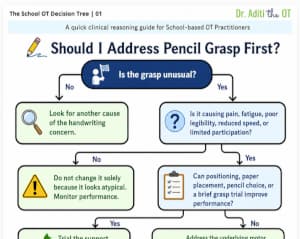
Before working on these pre-writing skills, I would need to make sure I address her pencil grasp.  I wrote a post about how I used fluency building on a post you can find here.

A Pre-Writing Skills Plan: What pre-writing strokes do students need to master to write letters ? 

If you look at the alphabet, all letters are made up of varying combinations of some basic pre-writing strokes.  

Dr. Aditi the OT - Alphabet Letter Strokes for A Pre-Writing Skills Plan

This is a list of all the pre-writing strokes that students need to be able to draw before writing letters:

  1. Vertical strokes
  2. Horizontal strokes
  3. Diagonal strokes
  4. Circular strokes
  5. Intersecting strokes +, x
  6. Semi-circle strokes

But, this is not just about being able to imitate these strokes on a broad scale. Students also need to be able to imitate these strokes in smaller proportions, especially if the expectation is to write within the lines in a notebook.

Plus, the motor control required for imitating a 6-inch vertical stroke is a lot different than motor control required for imitating a 3-inch or ¾-inch vertical stroke.  

Where do we start? Have students imitate long 6 to 8 inch strokes. But it is also important they make sure they can make shorter 3″ strokes from dot to dot too. That requires greater motor control. Then together we can develop further motor control with imitating 3/4″ strokes.

So this is the progression from vertical strokes to writing letters:

  1. Long vertical strokes (6 inches or more) free hand.
  2. Medium vertical strokes (3 inches or less) from dot to dot for motor control.
  3. Short vertical strokes (3/4 inches or less) from dot to dot for motor control.
  4. Fluency in drawing vertical ¾ inch strokes (60-80/min)

This progression would apply to all the aforementioned 6 pre-writing strokes students need for writing letters.

Here is an in-depth pre writing skills checklist. I often use this with my students to figure out what stage of fluency they are in and what pre-writing skills I need to build fluency on.   It is a resource you can download here:

Dr. Aditi the OT - Fluency Checklist Document for A Pre-Writing Skills Plan

A Pre-Writing Skills Plan: It’s all about Practice, Practice and more Practice!

In this super-short 10 second fluency timing video clip, you will see a student (Julia) working on imitating vertical strokes.

One of the biggest advantages of using fluency building is that practice is quick and easy.  Since the timings are in really short bursts, it is much easier to fit in practice opportunities and super easy to incorporate into the OT session, without taking up the entire session. 

For example, I may see Julia for OT for 15 mins/ week and even if we do 8 pre-writing skills practice trials (15 seconds/trial), it will only take approximately 2 minutes of the session.  So there are still approximately 10 mins of the session left to do some functional activities and perhaps we can even practice again, in the last 1-2 minutes?

Since building fluency requires consistent and frequent practice; it is super helpful to recruit other team members to run timings throughout the week on the days when the student does not have OT.  

I have asked parents, teachers, aides and other related services team members ( SLP, SW etc. ) to help out whenever possible.   Even if they help out with running 4 timings during their session, it only requires 1- 2 minutes of their time… which really isn’t a big ask.  I have found most people are super willing and helpful.

Plus there is nothing more reinforcing than the social reinforcement students get from showing off their newly learned skills.

To make fluency practice easier, I have also created a bundle of fluency building of pre writing stroke worksheets. You can access them here:

Dr. Aditi the OT - Photo of Worksheets for A Pre-Writing Skills Plan

How to collect data on pre-writing skills in a matter of minutes ?

Data collection is actually easier than you think when working on fluency based skills. Based on researched published fluency aims that you can find here, I set my fluency goal at 80/ min as my general fluency goal.  This would be my starting point. But, if I felt the student had some limiting factors and was not able to meet this goal, I may reduce my goal to 60/min.  This is where you will need to use your clinical judgment.

Based on this fluency goal, I know that my student needs to draw at least 80 correct strokes in a minute. At that rate, they are truly fluent and have mastered this skill. 

In Julia’s case we started with 10 second timings since she had significantly low tone and poor endurance.  I was able to complete 10- 12 practice timings in a session.  Starting with 4 at the beginning of my session and 4 at the end of the session (total of 1-2 minutes) building fluency in prewriting skills.  The data collection was quite rudimentary  at this initial stage.  I simply wrote down the number of correct and incorrect responses on a Post-it note like this…

Dr. Aditi the OT - Post-It Note Example for A Pre-Writing Skills Plan

The next stage was to plot the data so I could visually analyze progress. Even though we typically completed 8-10 fluency timings in a session, I would pick Julia’s best score and plot it on the SCC chart.

For example, if Julia’s best score was 10 correct strokes in 10 seconds, I would simply multiply this raw score of 10 correct by 6 (because there are six 10-second increments in a minute) to convert this to a 60 correct responses per minute score.

Similarly, I would multiply her number of incorrect raw scores by 6 to convert that to a per minute score and plot that with an ‘X’ on the chart.

Dr. Aditi the OT - Example Chart with Exercise Data for A Pre-Writing Skills Plan

What is the simple beauty of this chart?

Even if you are unfamiliar with the chart, you can simply visually look at the dots and figure out if progress is occurring.   If the dots are going up (progress is occurring) or if the dots are in plateau (i.e. no progress). You can also look at the trajectory of the data plotted with ‘x’ s in a similar fashion.  Below is an example of Julia’s data plotted on the Standard Celeration Chart:

By looking at the data (dots), you can see that Julia made good progress. You can also see that in just 3 weeks (each vertical line represents a day) she met her goal. 

At this point she was only doing 10 second practice trials. So, the next step would be to increase her endurance and work on 15 second timings and then 30 second timings.  As soon as she can imitate vertical strokes with a score of 80/min doing a 30 second timings, then I can infer that she has met this goal.  Building endurance is so important. Endurance ensures that Julia is not only fluent (and accurate) but also has the requisite endurance required for writing tasks.

If you are interested in learning more about the SCC, I have created an entire step by step presentation Intro To Charting Data in OT

How do you know if the treatment plan is working?

A pre-writing skills treatment plan is only as good as the outcome, so naturally you will want to assess if building fluency on these pre writing component skills (horizontal, vertical strokes etc.) is actually working to address the goal of writing letters.   If it isn’t then we are simply wasting our time.

So, think of the process of fluency building and taking data, as more of a formative assessment technique which “provides feedback and information during the instructional process, while learning is taking place, and while learning is occurring”. (NIU Center for Innovative Teaching and Learning. 2012). 

However, we also need a summative assessment, which often takes place after the learning has been completed and tells us if the skills are generalizing.  In other words we need to see if this newly learned pre-writing skill is applicable to what we actually wanted the student to be able to do or learn (write letters).

The summative assessment or what we call an ‘Application check’ in Precision teaching should occur throughout the fluency building process and can tell us if the work we are doing on building fluency in the pre writing skill is actually generalizing to address her ability to write letters.   

In Julia’s case, I choose to do an application check every 2 weeks or so, by asking her to write the first letter ‘J’ of her name. 

As you may recall at the beginning of the intervention, Julia could barely imitate a vertical stroke, however after 3- 4 weeks of fluency building this was one of her application checks:

This is a prime example of how building fluency in the pre-writing skills helped Julia make faster progress than expected. 

I hope this post provided a different perspective of addressing pre-writing skills.  With just some minor modifications to your existing treatment plan, you can elevate progress to the next level.   

Next time you are working with a preschooler on pre-writing skills, I hope you will give building fluency a try and leave me a note:)


References

Bernard-Opitz, V. (2005) Autism Spectrum Disorders: A training manual for parents, teachers and therapists.

Kubina, R.M., Jr., Morrison, R. and Lee, D.L. (2002), Benefits of adding precision teaching to behavioral interventions for students with autism. Behavioral Interventions, 17: 233-246. https://doi.org/10.1002/bin.122

Northern Illinois University Center for Innovative Teaching and Learning. (2012). Formative and summative assessment. In Instructional guide for university faculty and teaching assistants. Retrieved from https://www.niu.edu/citl/resources/guides/instructional-guide

Data collection in OT using a simple bead counter !

Not only is this a fun and crafty option for data collection, but it is a lot easier than carting around a big binder of data sheets & charts. Also, surprisingly using a bead counter is often super motivating for students AND it can be a useful non-visual data collection option (for the visually impaired student or practitioner perhaps ???)

Before I continue though, I want to give credit to a reader who is the reason I decided to write this article.

She emailed me and asked a very poignant question …

My first thought was.. what a brilliant question ?!?!?!? I tend to blabber-on about data collection all the time, but I have never really given much thought to adaptive non-visual options. Truth be told Gretchen had me a bit stumped.  Albeit just for a few minutes 🙂

Then I remembered learning about an article by Eric Haughton published in (1974) all about an alternative data collection method using a crafty little ‘Myriad counter’ (bead counter) for data collection. I started wondering if this hands free, low tech data collection system might be an option in this case.

While this bead counter concept was introduced simply as an alternative to using data collection sheets in the literature, it offered a new possibility. The tactile feature of the bead counter could serve as a great adaptive data collection option for the visually impaired, but I figured it may need a little tweaking.

Before we look at the potential adaptations .. let’s take a look at the original concept of using a bead counter for data collection.

So, what exactly is a bead counter?

A bead counter is basically a string of beads which are strung on one end of a string and then are slid down to the other end when taking data (one bead for each count). It is a simple hands-free tactile tool for collecting data.

This crafty tool is especially handy when you are tracking multiple behaviors, and when you have “all hands on deck” situations like self- contained classrooms and therapy in groups.

The bead counter is also a great data collection system for students to manage their own behavior/ goals, as long as they have the requisite fine motor skills to pinch and pull down one bead at a time.

A bead counter makes it a little easier to collect data on the go, and then you can always have the option to transfer your data into a Fluency data sheet or a Standard Celeration Chart

How to make a bead counter for data collection ?

For this version, all you need is some non resistive string, colored peony beads and a clasp.

Here is an example of how I would use this type of bead counter to collect data in my OT sessions in a school setting:

So in this example, I may take data on two different behaviors for the same student “Maya”.  I have assigned the red bead counter for ‘pulling hair behavior’ and the blue bead counter for ‘running off during circle time’.

I attach both bead counters to my belt and as I observe either behavior during the session, I keep count simply by transferring the respective beads down 1 at a time.   

If you are tracking high frequency behaviors that are likely to occur on more than 10 occasions in a session…then you may consider using two separate bead counters: a counter for the ones unit and another one for the tens unit.

The typical use of such bead counters, relies on the use of colored beads to make a distinction.  However, we can adapt this into a non-visual option for the visually impaired by adding tactile features which provide a greater distinction.  

How to adapt the bead counter for the visually impaired?

Both these aspects can be used to create a differentiation which can be felt rather than just seen.

A version made with laces ……

This could be a great option for the visual impaired and is a less fussy version of the traditional bead counter. The flat feature of the laces provide the resistance necessary to keep the beads in place and prevent them from slipping down.  Plus, using a lace can offer the option of having 2 bead counters in 1 longer format.

All you need is…a flat shoelace, a clip/clasp, two sets of 10 different sized or shaped beads.

  1. Get a flat athletic lace that is at least 24 inches in length. 
  2. Tie first knot in the lace so that the lace has two different length strands.
  3. Place a knot at the top of each strand.
  4. Thread nine beads and then leave a space and tie a 2nd knot at the bottom of each strand.
  5. Typically the fifth bead in each strand is a different color or in this case a different shape. (Just to provide you with a visual cue)

This ‘flat laced’ bead counter can be used in many different ways and can be customized for your data collection needs, for example:

Option A:

The longer strand of beads can be the one’s column and the shorter strand would be the ten’s column.

Option B:

The longer strand can indicate the number of correct responses, while the shorter strand can indicate the number of incorrect responses.

Option C:

Each strand can be used to count and collect data on different behaviors.

Can using a bead counter be motivating?

I cannot figure out a scientific reason for this, but yes it can!  This was my impression when I tried it out with some of my students.   They absolutely loved using the bead counter.  Apparently there is something very satisfying about sliding that bead down…. Go figure???

Perhaps it is the sheer fine motor act of pulling the bead down or maybe it’s just very visually appealing to ‘see’ your progress. For some students this act is reinforcing enough.  However, some students need a little more motivation and that’s when you may consider adding a tangible reinforcer.

For example, if 6yr old Johnny is working on writing his name, he may enjoy pushing a bead down for every letter written correctly AND after every 3 beads …. he can earn M&M’s or stickers etc.

Now if the student is still struggling, you can try adjusting the frequency of the tangible reinforcer, such that the student earns it more often. So maybe Johnny gets an M&M after EACH correct response/ bead transfer rather than having to wait to get 3 correct responses.

Other benefits of using the bead counter….

The bead counter may also helpful to create close ended activities to otherwise open ended tasks.  This is especially helpful for students who get overwhelmed easily or those who may experience sensory ‘shutdown’ when a demand is placed.  The beads help provide a visual/ tactile cue of the expected number of trials. 

Many students perform better when they know what to expect and that there is an end to the activity.  I have noticed this especially with students diagnosed with ASD.  Using the bead counter seems to lessen their anxiety and tends to increase overall engagement.  

The bead counter may also help modify difficult behaviors indirectly and discreetly.  How does that work?… you may be wondering.  Well, when you use the beads to ‘count’ a desired behavior, it brings more attention to that desired behavior and lessens the attention to the undesired behavior.  This reinforces or increases the occurrence of the desired behavior inadvertently.

FEEDING THERAPY: Using the bead counter to collect data on sensory aversions.

Here is an example of how I would use this bead counter as part of a sensory home program for a student we shall call “Justin”.  


While I have not used an actual bead counter for this type of case, I have used similar tangible methods of data collection for my feeding therapy clients in the past.   The key factor here is to include the student in the process and whenever possible, have them track their own behavior.

So in this example Justin is a picky eater with a diagnosis of ASD and an OT goal to increase the textures/ types of foods he eats.  He presents with a very strong gag reflex alongside the tactile and oral sensory aversions, which are all impacting his tolerance for eating new textures.  

First and foremost, it would be important to invest the time to teach Justin steps of using a bead counter. The sheer act of having Justin track his own exploration of foods or trial of new foods can provide a sense of control, in what tends to be a high anxiety situation.   

Also, being able to ‘feel’ or ‘visualize’ your own progress can be so empowering.  Plus, it also means there is less nagging, convincing going on, which in turn, tends to create a more positive relationship around food.    

So in Justin’s case, I may start off with tracking the number of times Justin willingly touches new foods, then move on to tracking the number of times he brings the new food to his lips.  Once he has met this goal, I could collect data on the number of times Justin licks the new foods.  Finally, I would start counting the number of actual bites taken of the new food.

Using a bead counter in this scenario not only provides an easier option for data collection, but it also offers a no pressure, no nagging option for both therapists and parents alike.  Who doesn’t like the sound of that?

Another thing I would do is to encourage parents or siblings to play along with their own bead counters.  This can be a great inclusive strategy and I may even add another contingency.  For example, “whoever moves the most beads during meal time gets to choose the TV show or doesn’t have to help with clean up after dinner.”  

It is always fun to try out different reinforcers, especially if there is data you can rely on.  The bead counter will tell you if it is working or if you need to try something else.

So whether you choose to use a bead counter or another method, remember that adding any medium for data collection can be highly impactful.    

Conclusion

Maybe it’s because I am an OT and love anything crafty, but doesn’t using a bead counter add a little pizazz to the ever so mundane, boring & dull process of data collection?  Plus who knew it had other motivational aspects? 

I cannot explain exactly how or why … but there is a definite dopamine laced ‘feel good’ sentiment around this process of data collection.  It reminds me of the feeling I get when crossing off items on my never ending ‘to do’ lists.  The sheer mechanics of it all conveys a sense of accomplishment and can be so very satisfying.

Will you give it a go?  Let me know if the comments below