

When a student uses an unusual pencil grasp, it is easy to focus immediately on correcting finger position. You might ask yourself, “Should I address pencil grasp first?”
But in school-based occupational therapy, the more important question is:
Is the grasp actually interfering with the student’s ability
to write and participate at school?
An unconventional grasp does not automatically mean that intervention is needed. The decision should be based on function—especially legibility, speed, comfort, endurance, and participation.
That is the reasoning behind this week’s School OT Decision Tree:
Should I Address Pencil Grasp First?

Start With Function, Not Appearance
Students use a variety of pencil grasp patterns. Some may look different from the classic dynamic tripod grasp but still allow the student to write efficiently, comfortably, and legibly.
A 2023 scoping review by Schneider and colleagues examined the relationship between pencil grasp and handwriting performance in school-age children. The authors found that inefficient grasp patterns may contribute to reduced legibility or fatigue in some students, but the overall research remains inconclusive.
Earlier research has also found that students using atypical grasp patterns did not necessarily demonstrate poorer handwriting legibility than students using a dynamic tripod grasp.
The takeaway for school-based OT is simple:
Do not treat the appearance of the grasp. Treat the functional problem.

The Pencil Grasp Decision Tree
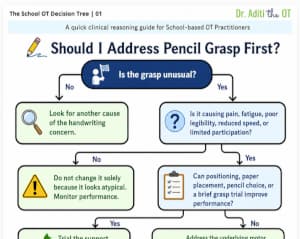
Simply complete the form to download the PDF directly.
Step 1: Is the Pencil Grasp Unusual?
If the grasp appears typical, it is worth considering other possible contributors to the handwriting concern.
For example:
- Letter-formation difficulty
- Poor visual-motor integration
- Reduced writing fluency
- Difficulty with spacing or sizing
- Postural instability
- Attention or executive-function demands
- Limited familiarity with the writing task
- Language or written-expression difficulty
If the grasp is unusual, continue through the decision process.
Step 2: Is the Grasp Affecting Performance?
This is the most important question.
Look for functional signs such as:
- Pain or discomfort
- Hand fatigue
- Reduced handwriting endurance
- Poor legibility
- Slow writing speed
- Excessive pencil pressure
- Difficulty keeping up with classroom writing
- Avoidance of written tasks
- Reduced participation in schoolwork
If none of these are present, changing the grasp may not provide a meaningful benefit.
In that situation, monitoring performance may be more appropriate than repeatedly correcting finger position.
Step 3: Try the Simple Changes First
Before introducing a pencil grip or trying to completely change the student’s grasp, look at the writing setup.
Small environmental changes can sometimes improve performance immediately.
Consider:
- Chair and desk height
- Feet supported on the floor
- Forearm supported on the table
- Paper placement
- Paper angle
- Pencil length
- Pencil diameter
- Pencil type
- Writing surface
- Amount of writing required
Writing demands themselves can also change how children use force and control the pencil, so performance should be considered within the actual task being asked of the student.
Step 4: Would a Brief Pencil-Grip Trial Improve Function?
A pencil grip should not automatically be prescribed simply because the student’s grasp looks unusual.
Instead, use it as a short clinical trial.
Ask:
Does the grip actually improve something meaningful?
Measure:
- Legibility
- Speed
- Comfort
- Endurance
- Pencil control
- Independence
- Student preference
If performance improves, continuing the support may be reasonable.
If performance does not improve, repeatedly repositioning the student’s fingers is unlikely to address the real problem.
Step 5: Look for the Underlying Contributor
If positioning changes and a brief grasp trial do not improve performance, broaden the assessment.
Possible contributors may include:
Does the student have adequate finger isolation and manipulation skills?
Postural control
Is the student using excessive hand tension because proximal stability is limited?
Visual-motor skills
Is the difficulty actually related to copying, spatial organization, or visual guidance?
Motor planning
Does the student understand how to form letters efficiently?
Task demands
Does handwriting break down only during longer assignments, copying from the board, timed tasks, or written composition?
This is where clinical reasoning becomes much more valuable than simply identifying the grasp pattern.
A School-Based OT Example – Should I Address Pencil Grasp First?

The grasp looks awkward, but the student:
✔ Writes legibly
✔ Keeps up with classroom assignments
✔ Reports no pain
✔ Does not fatigue
✔ Participates independently
There may be very little reason to spend therapy time changing the grasp.
Now imagine another student using the same grasp who:
* Stops writing after several minutes
* Complains that the hand hurts
* Writes significantly slower than peers
* Avoids longer written assignments
That is a very different clinical picture.
The grasp may now be worth examining—but even then, the goal is not simply to create a more typical-looking grasp.
The goal is to improve functional handwriting performance.
Clinical Takeaway
Current research indicates that several grasp patterns can support functional handwriting, and the evidence linking grasp pattern alone to handwriting performance remains limited.
For school-based occupational therapists, intervention decisions should be guided by whether the grasp affects:
Legibility. Speed. Comfort. Endurance. Participation.
Download the Pencil Grasp Decision Tree
Join the free Decision Tree Tuesday email series to receive the next one.
References
Dennis, J. L., & Swinth, Y. (2001). Pencil grasp and children’s handwriting legibility during different-length writing tasks. American Journal of Occupational Therapy, 55(2), 175–183. https://doi.org/10.5014/ajot.55.2.175

Educational resource only. Clinical decisions should be individualized to the student and educational context.
Continue building your school OT decision-making skills
Explore a related decision guide:
Browse the School OT Decision Tree Library for more practical guides.
Connect handwriting concerns to meaningful school participation
A pencil-grasp concern is one part of a larger school OT decision: how does it affect classroom participation, and what support belongs in the educational plan? Foundations 101 provides a broader grounding in the school model, educational relevance, IEP goal writing, collaboration, and documentation.
The School OT/PT Foundations 101 bundle includes two on-demand courses, four hours total, for $129. Explore the school model, IEP decision-making, service delivery, collaboration, and documentation.
See the Foundations 101 curriculum and enrollment options
Prefer to start with a free resource? Visit the homepage to sign up for the free pencil grasp decision tree and Decision Tree Tuesday emails.
[…] Should pencil grasp be the first intervention target? […]