

Does Every OT Concern Require Direct Therapy?
No—and that distinction matters in school-based occupational therapy.
When a student is struggling at school, the conversation can move very quickly from:
“There is a concern.”
to:
“How many minutes of OT should we add?”
But those are actually two different questions.

Before deciding how much OT a student needs, I think we need to ask:
What kind of support would actually change this student’s participation?
Sometimes that may be direct, individualized occupational therapy.
Sometimes it may be consultation with the teacher.
Sometimes changing the classroom routine may help not only one student—but ten.
And sometimes, after looking more carefully, OT may not be the right service at all.
Recent school-based OT research increasingly supports tiered, contextual, collaborative approaches rather than relying primarily on isolated, direct intervention (Lynch et al., 2023; Yngve et al., 2025, 2026).
The goal isn’t to provide the most intensive school-based occupational therapy services:
The goal is to provide the right level of support.
**Jump to:**
- The OT Level of Support Decision Tree
- My Story: Why More Minutes Aren’t Always Better
- What Recent Research Tells Us
- Tier 1: Start With the Environment
- When Consultation May Be Enough
- When I Consider Direct OT
- How I Decide Whether Support Is Working
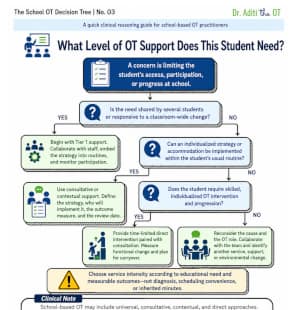
The OT Level of Support Decision Tree
By requesting this resource, you’ll also receive Decision Tree Tuesday and occasional School OT resources and updates from Dr. Aditi the OT.
You can unsubscribe at any time.
The Decision Tree begins with a simple premise:
A concern is limiting the student’s access,
participation, or progress at school.
Notice that I didn’t say:
“The student has a diagnosis.”
or:
“The student has an OT-related weakness.”
The starting point is educational participation.
From there, I work through several questions.
1. Is This Need Shared by Several Students?
This is a question I wish we asked more often.
Suppose several kindergarten students are struggling with cutting.
Or half of a first-grade classroom has difficulty with handwriting routines.
Or multiple students become dysregulated during the same transition.
We could immediately begin referring individual students.
But if the need is widespread, the more useful first step in school-based occupational therapy services may be:
What could we change for the whole classroom?
That is where a Tier 1 approach makes sense.
Collaborate with the teacher.
Embed a strategy into existing routines.
Then monitor whether participation improves.
2. Can an Individual Strategy Work Within the Student’s Normal Routine?
If the concern isn’t shared by the whole class, I next consider whether an individualized strategy can be implemented within the student’s actual school day.
Perhaps the student needs:
- a visual support,
- different seating,
- adapted paper,
- a modified writing tool,
- a shortened copying demand,
- a predictable transition routine,
- an environmental change,
- or a specific teacher cue.
If the strategy works in context, my role may be consultative or contextual.
That doesn’t mean I’m doing less.
It means the intervention is happening where the occupation actually occurs.
3. Does the Student Require Skilled, Individualized OT Intervention?
Sometimes the answer is clearly yes.
A student may require:
- skilled assessment,
- individualized intervention,
- systematic progression,
- ongoing clinical reasoning,
- adaptation based on response,
- and specialised instruction that cannot reasonably be delivered through classroom support alone.
That is where direct OT can absolutely be appropriate.
But even then, I want direct intervention connected back to the classroom.
The goal shouldn’t be:
“Student performs beautifully for 30 minutes in OT.”
The goal is:
“The skill shows up when the student needs it at school.”
My Story: Why More Minutes Aren’t Always Better
One of the patterns that has shaped my thinking in school-based OT is how easily a discussion about need turns into a discussion about minutes.
A student is struggling, and suddenly we are debating whether they need 20 minutes, 30 minutes, once a week, twice a week—or more.
But I’ve learned to stop myself before getting to that question.
I now ask:
“What exactly are we trying to change, and where does that change need to happen?”
Sometimes the best intervention really is direct OT.
But I’ve also seen situations where a simple strategy embedded into the student’s classroom routine made a far greater difference than practising the same skill with me in another room.
That shifted my thinking.
I stopped viewing direct OT as the highest level of care and consultation as something less.
They are simply different tools.
For me, the better question became:
What level of support gives this student the greatest chance of participating independently?
What Recent Research Tells Us About School-Based Occupational Therapy
1. Tiered School OT Is Increasingly Supported by the Evidence
Lynch et al. (2023) completed a scoping review examining evidence for tiered approaches in school-based occupational therapy.
Forty studies were included.
Individual-tier studies tended to focus on direct, remedial intervention for children at risk or with identified diagnoses.
By comparison, studies examining multi-tiered approaches relied more heavily on collaborative consultation embedded within the school context.
Importantly, positive outcomes for both students and school staff were associated with collaboration that was:
- timely,
- consistent,
- authentic,
- and embedded within school practice (Lynch et al., 2023).
What This Means at School
Direct intervention isn’t automatically the default.
Before pulling one child from class, ask:
Could I change something in the classroom that would address the same participation problem?
And perhaps help other students at the same time?
That is not reducing school OT.
That is using OT differently.
2. Changing the Environment Can Be an OT Intervention
Meuser et al. (2023) reviewed school-based interventions targeting the environments of children with special educational needs.
They found that participation could be supported through changes to both the physical and social school environment.
Their review also highlighted the value of occupational therapists working with teachers to match:
student needs + task demands + environment (Meuser et al., 2023).
What This Means at School
Sometimes the intervention target isn’t the child.
Maybe the student is struggling because:
- materials aren’t accessible,
- the routine is too complex,
- instructions are unclear,
- the environment is distracting,
- expectations aren’t developmentally matched,
- or the task demand is unnecessarily high.
Changing one of those things may produce more meaningful participation than trying to “fix” the student.
3. Classroom-Based Collaboration Can Build Teacher Capacity
Yngve et al. (2026) examined teacher–OT collaboration within the Partnering for Change model in Sweden.
Although the study was small, teachers involved in the approach demonstrated increases in self-rated knowledge, beliefs, and skills related to inclusive education.
Participants also described becoming more aware of:
- student diversity,
- classroom-wide adaptations,
- differentiated teaching,
- and shared problem-solving.
Classroom-based collaboration appeared to support the development of solutions that could be incorporated into everyday teaching (Yngve et al., 2026).
What This Means at School
A successful consultation shouldn’t create:
“Ask the OT every time this happens.”
Ideally, it creates:
“Now I know what to try when this happens.”
That’s capacity building.
And from a workload perspective, that can be incredibly powerful.
One good classroom strategy may support the teacher long after the OT has left the room.
4. Tiered OT Can Support More Than One Student at a Time
Yngve et al. (2025) studied the feasibility of the Partnering for Change model in Swedish schools.
Teachers and occupational therapists implemented 83 interventions across seven classes during the project.
Participants described positive effects for students and teachers, and the model was considered feasible within the participating schools (Yngve et al., 2025).
The study was relatively small, so I wouldn’t treat it as proof that one model will work in every school system.
But the idea is valuable.
What This Means at School
If eight students are struggling with the same classroom demand, eight separate referrals may not be our smartest first move.
Could we:
change the routine?
teach the skill class-wide?
coach the teacher?
modify the environment?
Then see who still needs something more individualised.
That’s the logic of tiered support.
5. Collaboration Needs a Purpose
Jeremy et al. (2024) conducted a scoping review of teacher–therapist collaboration in inclusive primary schools.
One of the important conclusions was that effective collaboration within school OT requires a clear purpose, and the intended outcomes of the collaboration need to be measured (Jeremy et al., 2024).
I love this point because “consultation” can sometimes become rather vague.
We shouldn’t have:
“OT consult monthly.”
and no one knows what that actually means.
Instead:
What is the strategy?
Who will implement it?
What outcome are we measuring?
When are we reviewing it?
That’s consultation with a clinical purpose.
Tier 1: Start With the Environment
When the same concern appears across multiple students, I consider whether there is a universal solution.
This might involve:
- classroom seating,
- handwriting routines,
- pencil-grasp instruction,
- cutting instruction,
- visual schedules,
- transition supports,
- movement opportunities,
- materials organisation,
- task setup,
- or teacher education.
The question is:
Can we make the environment work better before individualising the child?
Tier 1 does not mean every child receives OT treatment.
It means OT knowledge is used proactively to support participation.
Current tiered service research suggests that this more contextual approach may support inclusive school environments and allow occupational therapists to build school staff capacity (Lynch et al., 2023; Piškur et al., 2026).
When Consultation May Be Enough
Consultation works best when there is:
A specific problem
Not:
“Check in with him once a month.”
But:
“The student has difficulty initiating written work after whole-group instruction.”
A Specific Strategy
For example:
Provide a three-step visual checklist at the student’s desk.
A Clear Implementer
Who will actually use the strategy?
Teacher?
Paraprofessional?
Student?
A Measurable Outcome
Perhaps:
Student begins the writing task within two minutes with no more than one adult prompt.
A Review Date
Try the strategy.
Collect information.
Then decide:
Keep it? Modify it? Fade it? Escalate support?
Consultation should be active clinical reasoning—not simply a school OT service listed on the IEP.
Why Context Matters
Meuser et al. (2024) examined the experiences of teachers and occupational therapists using context-based collaboration in elementary schools.
Participants described collaboration as a developing partnership in which teachers and OTs learned from one another and applied strategies together in the classroom.
They also reported that this process supported children’s inclusion (Meuser et al., 2024).
What This Means at School
Sometimes I learn more by watching a student struggle for five minutes in the classroom than I do from twenty minutes of isolated testing.
Because now I can see:
- the desk,
- the noise,
- the materials,
- the teacher’s directions,
- peer demands,
- pacing,
- transitions,
- the length of the assignment,
- and the student’s natural response.
Context isn’t an inconvenience.
Context is clinical information.
When I Consider Direct OT
Direct intervention remains completely appropriate when the student needs skilled, individualised OT input.
I am more likely to consider direct intervention when:
- the student has not acquired an important functional skill,
- the skill requires systematic teaching or progression,
- adaptations alone are insufficient,
- the student needs repeated skilled feedback,
- the intervention requires ongoing adjustment based on performance,
- and the skill is meaningfully affecting educational participation.
But I still want a plan for carryover.
That may mean:
Direct OT + teacher consultation
rather than direct OT existing in isolation.
The direct intervention develops or changes the skill.
The contextual piece helps that skill show up in the student’s actual school day.
Time-Limited Direct Intervention Can Be Useful
I also don’t think every direct OT recommendation needs to imply:
“This student now receives this service forever.”
Sometimes a student needs an intensive period of skilled intervention.
For example:
- establish a new motor sequence,
- teach an efficient handwriting strategy,
- develop independence with equipment,
- build competence with a functional school task,
- or trial and refine an adaptation.
We can then measure the outcome and determine whether that intensity is still necessary.
The Decision Tree deliberately describes time-limited direct intervention paired with consultation.
That keeps us focused on progress rather than simply preserving minutes because they already exist.
When Direct OT May NOT Be the Answer
Suppose:
- the concern isn’t shared across the classroom,
- an individualized accommodation doesn’t solve it,
- and after assessment you still don’t see a skilled OT intervention that is likely to change educational participation.
That is useful information too.
The next step shouldn’t automatically be:
“More OT.”
Reconsider the cause.
Could the student need support involving:
- instruction,
- behavior,
- mental health,
- executive functioning,
- language,
- literacy,
- academic intervention,
- classroom management,
- attendance,
- or another service?
School-based occupational therapy services work best when we are willing to say:
This student has a need—but OT may not be the intervention for that need.
That’s good clinical reasoning, not a failure to provide service.
How I Decide Whether Support Is Working
No matter which level of support I choose, I want an outcome.
For example:
Classroom-Wide Support
Before: 9 students require adult assistance to organise materials.
After: 3 students require assistance after introducing a visual organisation routine.
That tells me something.
Consultation
Before: Student needs five prompts to begin written work.
Strategy: Three-step visual checklist.
After: Student begins with one prompt.
Useful information.
Direct OT
Before: Student independently fastens clothing needed for toileting 1 out of 5 opportunities.
After intervention: Student completes the task independently 4 out of 5 opportunities within the school routine.
Now I know whether my intervention is changing function.
The service model matters less than the outcome.
Don’t Choose Minutes Because They Are Convenient
I think this deserves saying plainly.
OT frequency should not be driven primarily by:
- what fits the schedule,
- what another student receives,
- diagnosis,
- what the student received last year,
- or a belief that more minutes automatically means more benefit.
The Decision Tree puts it this way:
Choose service intensity according to educational need and measurable outcomes—not diagnosis, scheduling convenience, or inherited minutes.
That is the principle I would want an IEP team to understand.
A Better Way to Think About the School OT Services Continuum
Rather than thinking:
Tier 1 → Consult → Direct OT
as:
little OT → medium OT → lots of OT
I think about them as different forms of expertise.
Universal / Tier 1
Change the environment or routine so more students can participate.
Consultative / Contextual
Create and support an individualized strategy in the student’s natural setting.
Direct OT
Provide skilled, individualized intervention when the student requires OT-specific teaching, progression, or clinical reasoning.
Reconsider OT’s Role
When the need is real but OT isn’t the service most likely to address it.
The strength of school OT is being able to move along that continuum.
The Bottom Line
The question isn’t:
“Does this student need OT?”
Not at first.
The more useful sequence is:
What is limiting participation?
Is the need shared by other students?
Can we change the classroom, routine, or task?
Can an individual strategy be embedded
into everyday school participation?
Does the student require skilled, individualized OT intervention and progression?
What measurable outcome will tell us
whether the support worked?
Recent research supports school-based occupational therapy practices and models that are collaborative, context-based, and flexible across levels of support rather than relying solely on referral-driven direct services (Jeremy et al., 2024; Lynch et al., 2023; Piškur et al., 2026; Yngve et al., 2025, 2026).
**My School OT Takeaway**
More OT isn’t automatically better OT.
The right service is the one that changes participation.
Get the OT Level of Support Decision Tree
Trying to decide whether a student needs classroom support, consultation, direct OT—or something else?
Download the School OT Decision Tree:
What Level of OT Support Does This Student Need?
Use it during referrals, IEP discussions, service reviews, or conversations about changing OT intensity.
Get the Next School OT Decision Tree
School-based OT rarely gives us tidy yes-or-no answers.
That’s why I created Decision Tree Tuesday—one practical clinical reasoning tool at a time, built around the real decisions we face in school-based practice.
Join Decision Tree Tuesday and get the next School OT Decision Tree delivered to your inbox.
More School OT Support
Looking for practical tools, templates, and clinical reasoning support for school occupational therapy services and practice?

References
Jeremy, J., Spandagou, I., & Hinitt, J. (2024). Teacher–therapist collaboration in inclusive primary schools: A scoping review. Australian Occupational Therapy Journal, 71(4), 593–611. https://doi.org/10.1111/1440-1630.12931
Lynch, H., Moore, A., O’Connor, D., & Boyle, B. (2023). Evidence for implementing tiered approaches in school-based occupational therapy in elementary schools: A scoping review. American Journal of Occupational Therapy, 77(1), 7701205110. https://doi.org/10.5014/ajot.2023.050027
Meuser, S., Borgestig, M., Lidström, H., Hennissen, P., Dolmans, D., & Piškur, B. (2024). Experiences of Dutch and Swedish occupational therapists and teachers of their context-based collaboration in elementary education. Journal of Occupational Therapy, Schools, & Early Intervention, 17(1), 37–53. https://doi.org/10.1080/19411243.2022.2143465
Meuser, S., Piškur, B., Hennissen, P., & Dolmans, D. (2023). Targeting the school environment to enable participation: A scoping review. Scandinavian Journal of Occupational Therapy, 30(3), 298–310. https://doi.org/10.1080/11038128.2022.2124190
Piškur, B., Baric, V. B., Yngve, M., Meuser, S., Goertzen, L., Daniels, R., Lidström, H., Kern, E., & Borgestig, M. (2026). International uptake of Partnering for Change (P4C): A Dutch and Swedish adapted version. Scandinavian Journal of Educational Research. Advance online publication. https://doi.org/10.1080/00313831.2026.2662237
Yngve, M., Baric, V., Lidström, H., & Borgestig, M. (2025). Feasibility of Partnering for Change (P4C) to create inclusive learning environments in Swedish compulsory schools. European Journal of Special Needs Education, 40(1), 161–175. https://doi.org/10.1080/08856257.2024.2334539
Yngve, M., Baric, V., Wilder, J., Borgestig, M., & Klang, N. (2026). Enhancing school professionals’ capacity for inclusive education: Interprofessional collaboration when using the Partnering for Change (P4C) in Sweden. European Journal of Special Needs Education. Advance online publication. https://doi.org/10.1080/08856257.2026.2636726
This article is intended for educational purposes. School-based occupational therapy services and decisions should be individualised according to the student’s educational needs, participation, school context, applicable requirements, and multidisciplinary team’s findings.
Continue building your school OT decision-making skills
Explore a related decision guide:
Browse the School OT Decision Tree Library for more practical guides.
Build confidence in school OT service recommendations
Choosing between classroom supports, consultation, and direct services also means explaining educational impact, collaborating with the team, and documenting the reasoning. Foundations 101 covers service delivery, IEPs, goal writing, collaboration, and progress monitoring for practitioners entering school-based practice.
The School OT/PT Foundations 101 bundle includes two on-demand courses, four hours total, for $129. Explore the school model, IEP decision-making, service delivery, collaboration, and documentation.
See the Foundations 101 curriculum and enrollment options
Prefer to start with a free resource? Visit the homepage to sign up for the free pencil grasp decision tree and Decision Tree Tuesday emails.