

What Sensory Regulation Support Does This Student Need Right Now?

School-based OT sensory regulation support should match the student’s current needs and participation goals. Use this five-stage guide alongside the student’s individualized plan.
You’ve created a sensory plan. You’ve identified strategies that seem to help. But then something frustrating happens.
A movement activity that helped a student become alert and engaged yesterday seems to make them more dysregulated today. Or the student who needed movement first thing in the morning becomes overwhelmed by additional input later in the afternoon. Did the strategy stop working?
Not necessarily. The student’s regulation needs may have changed. That’s why instead of asking, “What sensory strategies work for this student?” I want us to start asking:
“What does this student need right now?”
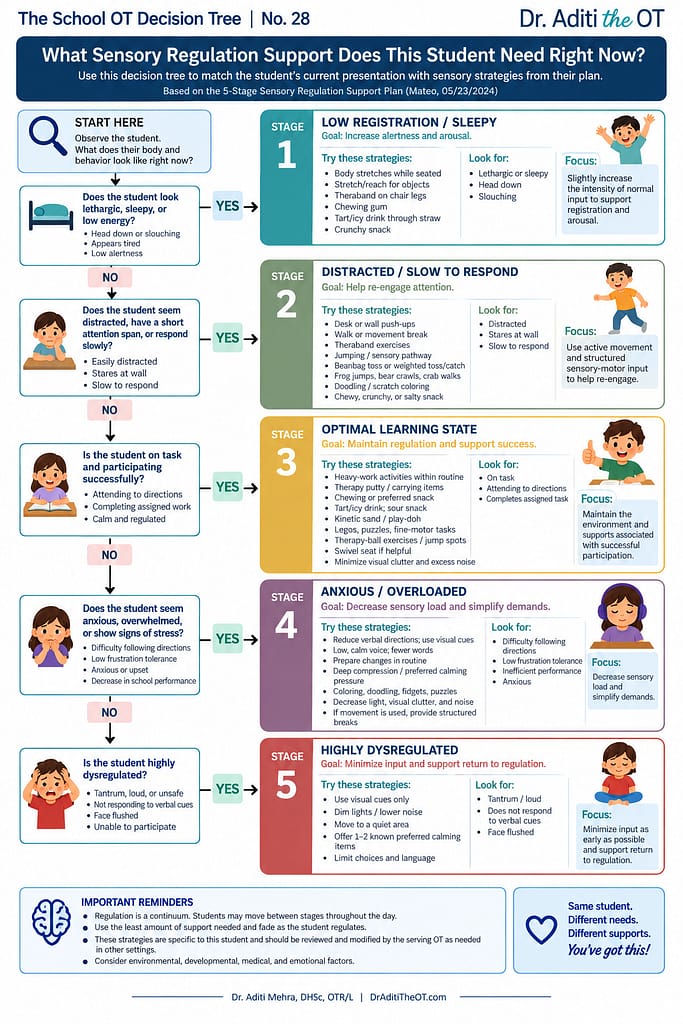
Sensory Regulation Support: Decision Tree #28
Regulation Isn’t a Fixed State
Students can move through different states of regulation throughout the school day. A student may arrive sleepy and lethargic. Later, they may be distracted and slow to respond.
During a preferred classroom activity, they may be calm, attentive, and successfully participating. Then a noisy assembly, unexpected schedule change, difficult assignment, fatigue, or another demand may contribute to overwhelm. Same student. Different needs. Different supports.
That’s the idea behind my 5-Stage Sensory Regulation Support Plan.
Stage 1: Low Registration / Sleepy
The student may appear lethargic, sleepy, low energy, or slouched. The goal at this stage is to increase alertness and arousal. For a student whose individualized plan includes them, strategies might include stretching, reaching, Theraband at the chair, chewing, crunchy snacks, or an appropriate cold drink through a straw.
The key is to slightly increase the intensity of familiar input to support alertness—not simply provide random sensory stimulation.
Stage 2: Distracted / Slow to Respond
Now the student is awake but may be easily distracted, staring away from the task, or slow to respond. Here, the goal is re-engagement. Structured movement or sensory-motor activities already identified as appropriate for the student might help them return attention to the task.
But again, we’re not choosing movement simply because “movement is sensory.” We’re asking: Does this support help this particular student re-engage and participate?

Stage 3: Optimal Learning State
This may be the most overlooked stage. The student is calm. Attending.
Following directions. Completing the task. We don’t need to fix this.
At Stage 3, the goal is to maintain the environment and supports associated with successful participation. Sometimes our best intervention is recognizing that the student is regulated and not unnecessarily changing what’s working.
Stage 4: Anxious / Overloaded
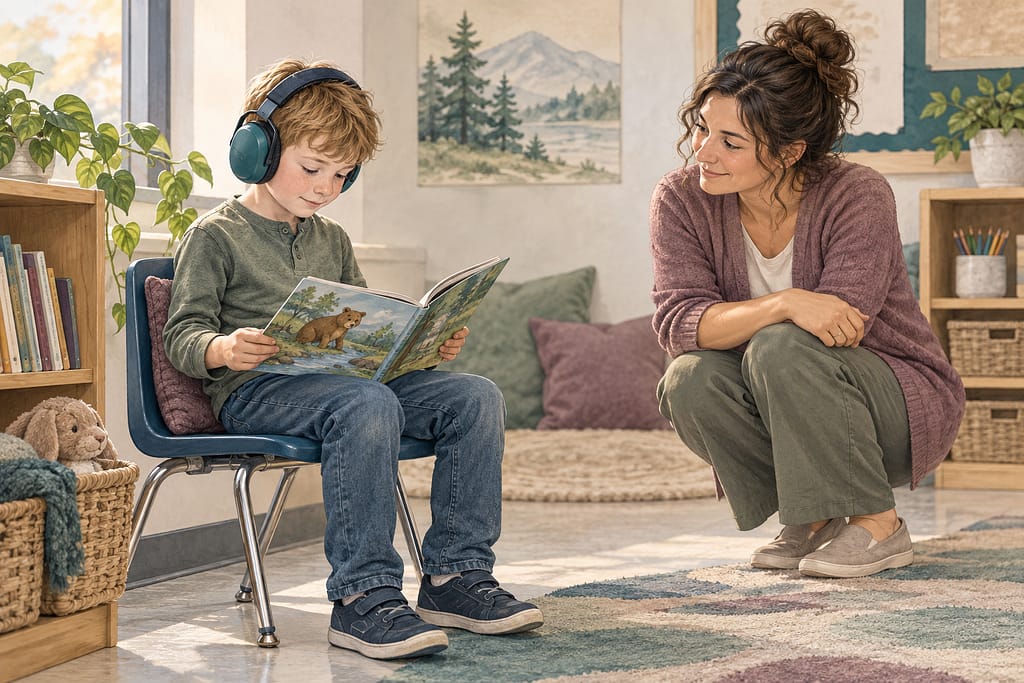
Now the direction of support changes. The student may appear anxious or overwhelmed, have difficulty following directions, demonstrate low frustration tolerance, or show decreased school performance. Rather than adding more stimulation, the goal becomes to decrease sensory load and simplify demands.
That might mean reducing verbal directions, increasing visual cues, lowering noise, providing fewer words or choices, preparing the student for changes in routine, or using familiar calming supports from the student’s plan.
The question is no longer: “How can I give this student more sensory input?” It’s:
“What can I reduce?”
Stage 5: Highly Dysregulated
At this point, the student may be extremely distressed, loud or unsafe, unable to participate, or minimally responsive to verbal cues. This isn’t the time for lengthy explanations or introducing a brand-new coping strategy. The goal is to minimize input and support a return toward regulation.
Use familiar supports already identified for the student, reduce language and choices, decrease environmental demands, and follow applicable school safety and support procedures. As regulation returns, support can change again.
The Same Strategy Isn’t Right for Every Moment
This is one of the biggest problems I see with the way we sometimes talk about sensory strategies. We ask: “What works for this child?”
Then we create a list. Movement break. Theraband.
Chewy. Fidget. Headphones.
But a list doesn’t tell the educational team when a strategy should be used, why they’re using it, or what change they’re looking for afterward. A strategy intended to increase alertness may not make sense when a student is already overloaded. And a strategy designed to decrease stimulation may not help a student who is sleepy and struggling to engage.
The strategy needs to match the student’s current presentation and functional goal.
Sensory Regulation Is a Continuum
There’s another important point. These five stages aren’t diagnoses. And they aren’t permanent categories.
A student isn’t a “Stage 4 student.” The stages are simply a way of organizing what we’re observing so that we can make a more intentional decision about support. Students may move between stages throughout the day.
That means support should be dynamic, too. And sensory processing isn’t the only factor affecting regulation. Environmental, developmental, medical, emotional, instructional, and task-related factors may also influence what we’re seeing.
Start With the Student, Not the Strategy
Before reaching for a sensory tool, observe. What does the student’s body and behavior look like right now? Are they under-responsive?
Distracted? Successfully participating? Overloaded?
Highly dysregulated? Then ask: What are we trying to change?
Increase alertness? Re-engage attention? Maintain successful participation?
Decrease sensory load? Support a return toward regulation? Only then should we choose a strategy from the student’s individualized plan.
That’s a very different approach from simply asking: “What’s a good sensory activity for this child?” And it’s the principle I want practitioners to remember:
Same student. Different needs. Different supports.
Download Decision Tree #28
I’ve created School OT Decision Tree #28: What Sensory Regulation Support Does This Student Need Right Now? to help school teams match the student’s current presentation with appropriate strategies from their individualized sensory plan.
Want a new school-based OT clinical reasoning tool every week?
By signing up, you’ll receive Decision Tree Tuesday and occasional School OT resources and updates from Dr. Aditi the OT. You can unsubscribe at any time.
Related School OT Resources
Is sensory processing affecting school participation? Explore the related decision guide, or browse the School OT Decision Tree Library.
Aditi Mehra, DHSc, OTR/L
School-Based OT Educator & Author
Dr. Aditi the OT
Educational resource only. Clinical decisions should be individualized to the student and educational context.