

“My Students Keep Writing Their 2s Backward.”
I have been hearing some version of this from teachers over and over:
“They keep reversing 2.”
And then:
“They’re doing it with 3 and 5, too.”
Number reversals can certainly be part of early development. But when children are first learning how to form numerals, this is also a perfect opportunity to teach a consistent motor pattern before an inefficient pattern becomes the one they practice over and over.
So I started experimenting with a very simple idea.
Could we make number formation easier to remember by pairing the movement with a short verbal cue?
Not a paragraph.
Not four separate directions.
Just a phrase that a five-year-old can actually say while the pencil is moving.
My First Cue for Number 2 Was Too Complicated
Originally, I developed a much more detailed verbal sequence for writing 2:
“Curve to the right, slide down to the left, touch the bottom line, slide to the right.”
Technically, it described the movement.
Functionally?
It was too much.
When I tried it with kindergartners, I could immediately see that they were having to process far more language than they needed.
Then I shortened it to:
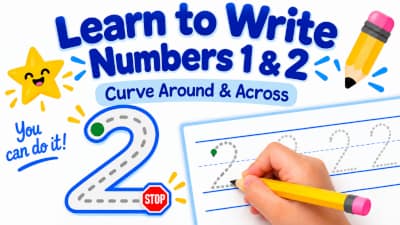
“Curve around and across.”
That was different.
The children could remember it.
They could say it while writing.
And, most importantly, they could do it.
That classroom experience changed how I am approaching this entire number-writing series.
The goal isn’t to describe every millimeter of pencil movement.
The goal is to give children just enough language to organize the movement.
What Does the Research Tell Us About Handwriting Practice?
Recent occupational therapy research supports a cognitive and task-specific approach to early handwriting instruction.
A 2024 study of 408 children in their first two years of formal schooling found that accurate handwriting involves much more than moving the pencil. Children also need to attend, remember what the symbol should look like, plan how to produce it, monitor what they are doing, and evaluate the result. Difficulties with planning and recall were particularly evident in beginning writers.
That finding matters.
A child who reverses a symbol may not simply need “stronger hands.” The child has to remember the movement pattern and retrieve it efficiently enough to produce the symbol correctly.
Mathwin, Chapparo, and Hinitt also reported in 2023 that children struggling with letter formation improved alongside changes in their use of cognitive strategies. The authors concluded that cognitive strategy training can be incorporated with handwriting instruction for beginning writers who are having difficulty learning correct formations.
And a 2023 occupational therapy scoping review found that handwriting programs incorporating task-specific motor-learning practice were the interventions associated with statistically significant handwriting improvements in the studies reviewed. Interventions that did not actually involve handwriting practice did not demonstrate the same benefit.
In other words:
If we want children to get better at writing, they need opportunities to actually write.
Number Reversals and Number Formation – What About Verbal Cues?
This is where I want to be careful about what the research does—and does not—tell us.
There is not strong recent research demonstrating that the exact phrase “curve around and across” is superior to another phrase for teaching the numeral 2.
What we do have is a broader evidence base supporting explicit formation instruction, cognitive strategies, visual cues, modeling, and repeated handwriting practice. Earlier occupational therapy handwriting programs also specifically incorporated simple, consistent verbal and visual cues for formation alongside repeated practice.
So I see the verbal cue as a memory strategy, not magic words.
The visual tells the child where to go.
The verbal phrase gives the child something short enough to remember while the hand completes the movement.
For number 2:
Curve around and across.
That’s it.
Why I Created the “Learn to Write Numbers 1 & 2” Video
I wanted something teachers and parents could use for a few minutes rather than another long handwriting lesson.
In the video, children see the number being formed, hear the verbal cue, and then have repeated opportunities to practice along with it.
For Number 2, children hear:
“Curve around and across.”
The formation is practiced five times during the activity.
There isn’t research showing that exactly five repetitions is the ideal dosage. I chose five intentionally because it provides several immediate practice opportunities without making a kindergarten handwriting activity unnecessarily long.
That is an important distinction.
More repetitions are not automatically better if the child becomes tired, disengaged, or begins practicing the movement incorrectly.
I would rather have a child complete five attentive, correctly cued repetitions than twenty rushed ones.
🎥 Watch: Learn to Write Numbers 1 & 2
Encourage children to write along rather than simply watch the video.
Try This With Your Students
The activity is intentionally simple:
- Watch the movement. Have the child locate the starting point and watch how the number is formed.
- Say it while writing. For 2, say “curve around and across” as the pencil moves.
- Practice it five times. Then see whether the child can produce the numeral with less visual support.
Eventually, the goal is to fade the adult prompt.
You don’t want a second grader who still needs an adult standing next to them saying, “curve around and across.”
You want the phrase to help establish the motor plan and then gradually become unnecessary.
Free Number 2 Handwriting Practice Worksheet
I also created a matching worksheet so children can practice away from the video.
The worksheet includes guided tracing followed by opportunities to write the numeral independently on handwriting lines. Here is a preview:

Want to Download the FREE Number 2 Practice Worksheet?
How about a full, 11-page instructional download, covering Numbers 1 & 2? Enter your email and get the full PDF.
By requesting this resource, you’ll also receive Decision Tree Tuesday and occasional School OT resources and updates from Dr. Aditi the OT. You can unsubscribe at any time.
Teachers can use it after the video, send it home for brief practice, or place it in a handwriting/MTSS station.
The video provides the model + verbal cue.
The worksheets provide the practice.
What About Backward 2s?
I am also incorporating visual discrimination into the activities because children need to recognize what the correctly oriented numeral looks like—not just reproduce a movement.
That means asking children to compare a correctly facing 2 with a backward 2, find correctly oriented 2s, and connect the numeral 2 with groups containing two objects.
That gives us several different routes into the same concept:
See 2 → recognize 2 → say the movement → write 2 → connect 2 with quantity.
For some students, that combination may be more useful than simply handing them another page containing twenty dotted 2s to trace.
The Bottom Line
Handwriting instruction does not have to be complicated.
In fact, my experience with these kindergartners reminded me that sometimes our professional instinct is to add more explanation when young children actually need less language and more meaningful practice.
For Number 2, I started with:
Curve right. Slide down left. Touch the bottom line. Slide to the right.
The children showed me something simpler worked better:
Curve around and across.
Short enough to remember.
Short enough to say while writing.
And paired with actual handwriting practice.
That is the approach I will be using as I continue building the rest of this number-formation series.
Next up: Number 3.
If you try this approach for number 2 with your students, I genuinely want to know what happens.
Did the shorter verbal cue help? What number is giving your students the most trouble?
References – Number Formation Reversals in Kindergarten
Mathwin, K., Chapparo, C., & Challita, J. (2024). Cognitive strategies utilised by early learners when writing alphabet-letters from memory. Australian Occupational Therapy Journal, 71(5), 699–717. https://doi.org/10.1111/1440-1630.12956
Mathwin, K., Chapparo, C., & Hinitt, J. (2023). Children with handwriting difficulties: Impact of cognitive strategy training for acquisition of accurate alphabet-letter-writing. British Journal of Occupational Therapy, 86(6), 451–461. https://doi.org/10.1177/03080226221148413
Cole, A. (2023). Occupational therapy intervention to address handwriting deficit in elementary-aged school children: How to, how much, and how often? A scoping review. Journal of Occupational Therapy, Schools, & Early Intervention, 16(3), 368–381.
Case-Smith, J., Holland, T., & Bishop, B. (2011). Effectiveness of an integrated handwriting program for first-grade students: A pilot study. American Journal of Occupational Therapy.
This information is intended for educational purposes and is not a substitute for individualized occupational therapy evaluation or intervention.