

Keep Remediating Handwriting—or Add an Alternative?
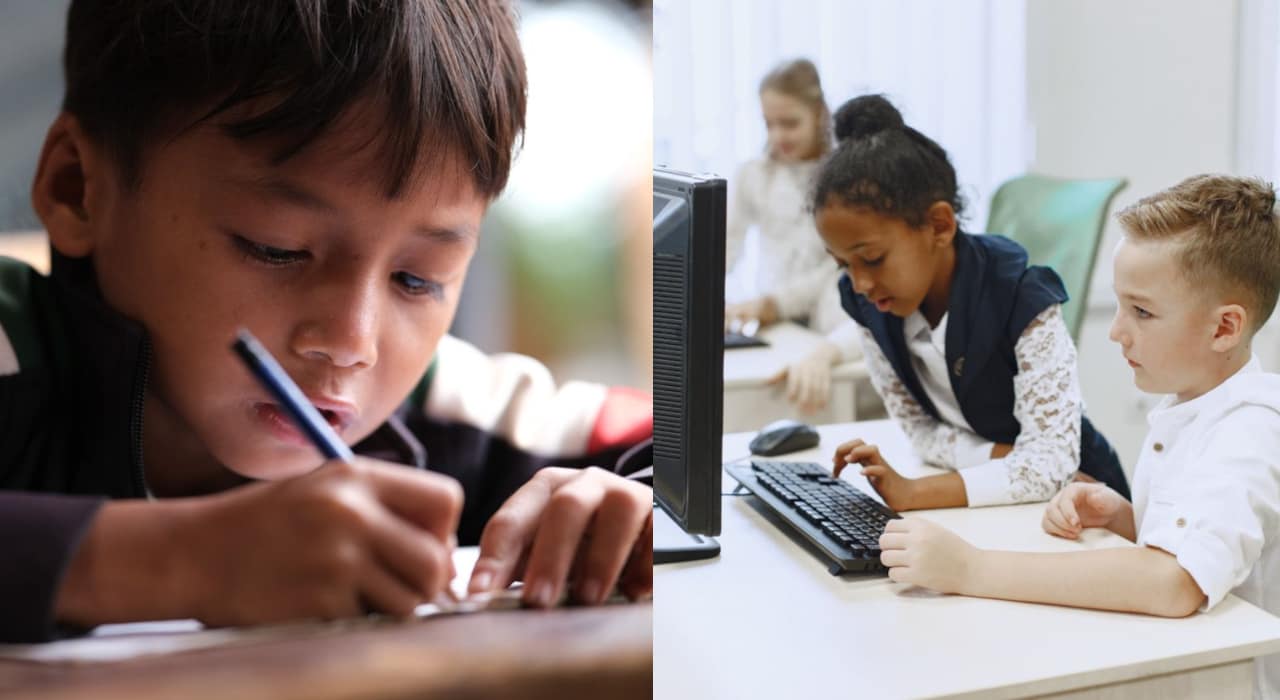
You’ve been working on handwriting with a student.
There has been instruction, practice, and support, but written assignments are still taking too long. The student struggles to get ideas onto paper, becomes fatigued, or simply cannot produce enough written work to meet classroom demands.
At some point, an important question comes up:
Do we keep working on handwriting—or introduce another way to write?
In school-based OT, I don’t think this needs to be an either/or decision.
Download the Decision Tree

By requesting this resource, you’ll also receive Decision Tree Tuesday and occasional School OT resources and updates from Dr. Aditi the OT.
You can unsubscribe at any time.
Has Handwriting Had a Fair Trial?
Before deciding handwriting “isn’t working,” we first need to consider what instruction the student has actually received.
Has there been explicit, targeted handwriting instruction?
Has the student had adequate opportunities to practice?
Was progress monitored?
And importantly, what happened?
If handwriting is showing meaningful functional improvement, continuing an effective approach may make sense while supporting carryover into the classroom.
But if progress isn’t translating into functional school performance, we need to look more closely at the demands being placed on the student.
Can Accommodations Reduce the Barrier? Handwriting vs Keyboarding
The next question isn’t necessarily, “Should we give the student a keyboard?”
Sometimes the barrier can be reduced through accommodations.
That might include reduced copying, additional time, access to notes, or an alternate response format.
The important part is to monitor the outcome.
Does the accommodation actually improve the student’s ability to access and complete the task?
If it doesn’t, we may need to consider another method.
When Should We Trial an Alternative?
Keyboarding, speech-to-text, word prediction, or another appropriate tool may provide another route for written expression.
But simply providing access to technology isn’t enough.
Students need instruction in how to use the tool, and we need to determine whether it actually improves performance.
That means comparing meaningful outcomes such as:
- accuracy and quality,
- speed,
- independence,
- fatigue, and
- participation.
A tool that looks promising isn’t necessarily the right tool for every student—or every writing task.
It Doesn’t Have to Be Handwriting OR Technology
This may be the most important point:
Adding an alternative does not mean abandoning handwriting.
A student can continue developing handwriting while also having access to another method when the purpose, task, or demands make it more appropriate.
The goal isn’t to defend one writing method.
The goal is to help the student successfully communicate and participate in schoolwork.
Download Decision Tree – Handwriting vs Keyboarding School OT
I’ve created School OT Decision Tree #06: Keep Remediating Handwriting—or Add an Alternative? to help you work through this decision systematically.
Get the Next School OT Decision Tree
School-based OT rarely gives us tidy yes-or-no answers.
That’s why I created Decision Tree Tuesday—one practical clinical reasoning tool at a time, built around the real decisions we face in school-based practice.
Join Decision Tree Tuesday and get the next School OT Decision Tree delivered to your inbox.
More School OT Support
Writing-access decisions are part of a wider school OT role. Strengthen your foundation in educational relevance, IEPs, service delivery, and collaboration with the two-part Foundations 101 bundle: four hours of on-demand learning for $129.
Educational resource only. Clinical decisions should be individualized to the student and educational context.
Aditi Mehra, DHSc, OTR/L, School-Based OT Educator & Author
Dr. Aditi the OT